
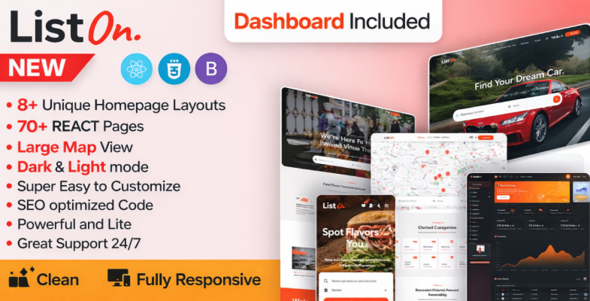
ListOn React Template
ListOn is a complete React-based directory and listing template built for creating modern,
content-rich websites with an advanced management dashboard. It combines a public website
and an administrative interface in one unified project, making it suitable for platforms
that need both customer-facing browsing and internal content control.
The template is designed for applications such as business directories, property listing
portals, marketplace platforms, service discovery websites, restaurant directories, travel
listings, vehicle marketplaces, and booking systems. It provides the structure, design, and
reusable components needed to launch a polished listing product quickly.
Overview
The project uses React 19 and Vite as its foundation, which gives it a fast development
workflow and a modern component-driven architecture. It also relies on Bootstrap 5, Redux
Toolkit, React Router, and several utility libraries to handle layout, routing, state
management, animations, charts, forms, and maps.
One of the main strengths of the template is that it brings together two major experiences:
a front-facing website for visitors and a dashboard for administrators. The website focuses
on showcasing listings and content, while the dashboard is built for managing listings,
messages, bookings, reviews, wallets, and account settings.
Main Features
ListOn includes eight homepage variations, giving developers flexibility to choose the
visual style that best matches the target business. It also includes multiple listing views,
blog pages, authentication pages, profile pages, contact pages, and other template pages
that help fill out a full directory application.
The dashboard is equally extensive. It contains analytical views, listing management tools,
booking management, messaging interfaces, review moderation, bookmarks, wallet pages, and
settings screens. This makes the project useful not only for displaying listings but also
for controlling the full operational workflow behind them.
The template also includes:
- Responsive layouts for desktop, tablet, and mobile devices
- Unified dark mode across website and dashboard
- Dynamic CSS loading to prevent style conflicts
- Lazy loading for improved performance
- Redux slices for navigation, map state, chat, and filters
- Google Maps integration for location-based listings
- Charts and analytics for dashboard reporting
- Formik and Yup support for form handling and validation
- Toast notifications for user feedback
- Security support through DOMPurify for HTML sanitization
Architecture
The project uses a dual-layout architecture. The public website is wrapped in one layout
and the dashboard is wrapped in another, allowing each side of the application to load its
own styles and behavior without interfering with the other.
This approach helps keep the codebase organized and maintainable. Website-specific pages can
focus on branding, browsing, and conversion, while dashboard pages can focus on management
tasks and administrative workflows. The documentation highlights this separation as one of
the core design decisions behind the project.
The template also uses React.lazy with Suspense to split page components into smaller chunks.
That reduces the amount of code loaded upfront and helps improve runtime performance, which
is especially useful for a large template with many routes and page variants.
CSS System
The documentation places a strong emphasis on CSS isolation. Because the website and
dashboard were merged into one codebase, their styling needs to stay separate. To solve this,
the template uses dynamic CSS injection and cleanup through a custom hook.
Website pages load their own styles, dashboard pages load their own styles, and shared
utilities such as the page loader remain available globally. This prevents conflicts and
helps each section of the application preserve its intended visual language.
Theme System
ListOn includes a unified theme context that keeps dark mode synchronized between the
website and dashboard. The theme updates both Bootstrap’s data attribute and the dashboard’s
dark-mode class so that the two layouts stay visually aligned.
Theme preference is also stored in local storage, which allows the user’s choice to persist
across reloads. This makes the experience feel consistent and avoids forcing the user to
choose a theme every time they return to the application.
Why This Project Stands Out
Unlike a basic landing page or a simple listing demo, ListOn is structured as a full product
foundation. It is not only about showing listings, but also about supporting the systems
around them: content management, communication, analytics, user accounts, and responsive
presentation.
The template is especially valuable for teams that want to save time on setup while still
starting from a well-organized and feature-rich codebase. The documentation shows that the
project is intended to be customizable, scalable, and ready for real-world usage rather than
being a minimal starter.
Best Use Cases
ListOn works well for real estate websites, hotel and travel directories, local service
marketplaces, auto marketplaces, restaurant discovery platforms, and other listing-based
products. It is also useful for agencies or product teams that need a balanced combination
of public content presentation and internal admin tools.
If a project needs a modern UI, structured routing, reusable components, theme support,
dashboard controls, and a practical starting point for a directory platform, ListOn provides
a strong base to build on.
Summary
In short, ListOn is a comprehensive directory and listing React template with a powerful
dashboard, flexible homepage designs, thoughtful architecture, and modern front-end
practices. It is built to support both appearance and functionality, giving developers a
complete foundation for creating professional listing applications.